


Why This Fear Even Exists
Older laser machines used a single wavelength of light. That light hunted for melanin, the pigment that gives your skin and hair their color. The problem? Darker skin has more melanin sitting right at the surface. So when the old lasers fired, they couldn’t always tell the difference between your hair and your skin. They would sometimes zap both.
The result was burns, dark spots, or light spots that could take months to fade. Some patients were left with scars. Word spread fast, and honestly, it made sense for people to be cautious.
But here’s what a lot of people don’t know: this was a problem with the machines, not a problem that can never be solved. And it has been solved.
What Actually Changed
Longer wavelengths
Cooling technology
Put those two things together, and you get a treatment that can be tailored to your exact skin type, not a one-size-fits-all blast.
Understanding Your Skin Type: The Fitzpatrick Scale
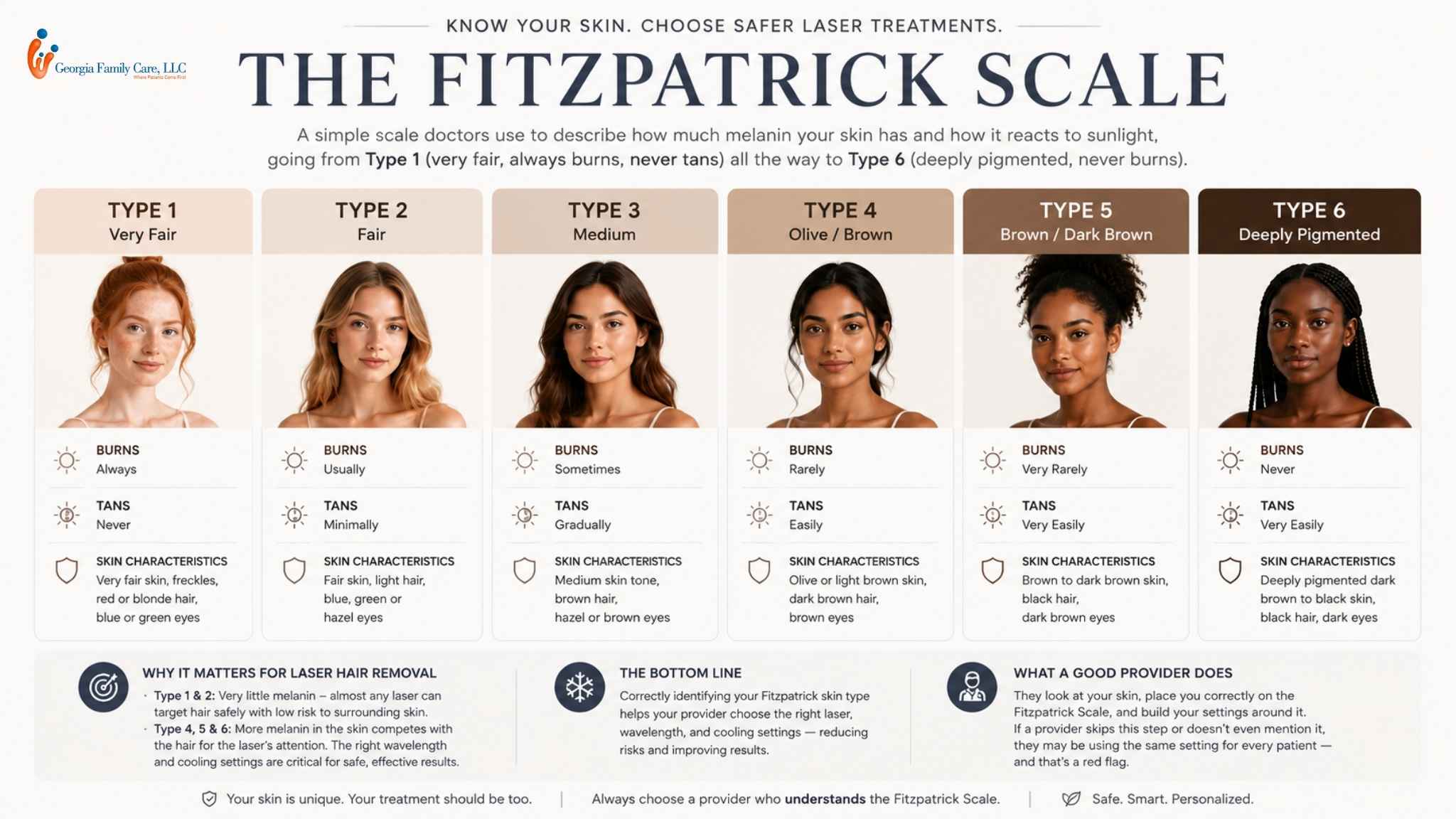
Here’s why this matters so much for laser hair removal. Type 1 and Type 2 skin has very little melanin, so almost any laser can target hair safely without much risk to the skin around it. But once you move into Type 4, 5, and 6, the skin itself starts competing with the hair for the laser’s attention. That’s exactly where wavelength choice and cooling settings stop being optional extras and start being the whole reason a treatment succeeds or fails.
A provider who understands the Fitzpatrick scale doesn’t guess. They look at your skin, place you correctly on that scale, and build your settings around it. If a provider skips this step, or doesn’t even mention it, that’s usually a sign they’re running one setting for every patient who walks in the door.
Myth vs. Fact: Let's Clear This Up
Why Medical Supervision Is the Real Difference Maker
At GA Family Care, treatments are provided under medical supervision. That difference shows up in ways you can actually feel and see.
A medically supervised provider knows how to:
● Read your Fitzpatrick skin type correctly and choose settings that match it
● Recognize early signs of a reaction and adjust before it becomes a problem
● Understand how medications, hormone levels, or skin conditions might affect your treatment
● Customize your plan instead of running everyone through the same settings
A standard spa esthetician is trained to run a machine. A medical team is trained to think through your specific case, your skin, your history, your goals, and make judgment calls when something doesn’t look quite right.
When you’re dealing with something as sensitive as melanin-rich skin, that judgment call can be the difference between a smooth result and a patch of skin that takes six months to heal.
What to Expect From a Custom Treatment Plan
At GA Family Care, your visit typically starts with a real conversation. We look at your skin tone, your hair color and thickness, the area you want treated, and any history that might affect the plan, like certain medications or skin sensitivities.
From there, we choose:
● The right laser wavelength for your skin type
● The right energy setting, strong enough to target the follicle, gentle enough to protect your skin
● The right cooling method to keep you comfortable and safe
● A realistic session schedule, since hair grows in cycles and most people need multiple visits spaced a few weeks apart
This isn’t a guessing game. It’s a plan built around your body, not a generic package sold to everyone who walks through the door.
Laser Hair Removal vs. Shaving, Waxing, and Other Methods
Shaving – It is fast and cheap, but it only cuts hair at the surface. It grows back within a day or two, and it can leave dark skin prone to razor bumps and ingrown hairs, especially in areas like the bikini line or underarms.
Waxing – It pulls hair from the root, so regrowth takes longer, usually a few weeks. But it can also irritate the skin, and repeated waxing on melanin-rich skin sometimes leads to dark spots that take a while to fade, especially if the technician isn’t careful.
Depilatory creams – Dissolve hair chemically. They’re painless to apply, but the chemicals can be harsh on sensitive or darker skin, and results only last a few days.
Laser hair removal – It works differently from all of these. Instead of just removing hair that’s already there, it targets the follicle itself, the part of your skin responsible for growing new hair. Over a full series of sessions, many follicles stop producing hair altogether. That’s why laser is the only option on this list that can lead to long-term, lasting reduction instead of a quick, temporary fix.
The tradeoff is time and cost upfront. Laser takes multiple sessions spread over months, and it costs more per visit than a razor or a tub of wax. But when you add up the years of shaving, waxing appointments, and ingrown hair treatments most people go through, laser often ends up being the more practical choice in the long run.
Common Side Effects and How They're Handled
Normal and expected: Mild redness and slight puffiness around each hair follicle right after treatment. This usually looks a bit like small goosebumps and calms down within a few hours to a day.
Worth mentioning to your provider: Itching that lasts more than a day or two, or skin that feels unusually tender to the touch.
Not normal, and a sign something went wrong: Blistering, burns, or patches of skin that turn noticeably darker or lighter and don’t fade within a few weeks. These reactions usually point to a laser setting that was too aggressive for the skin type being treated, which circles back to why medical oversight and correct settings matter so much from the very first session.
At GA Family Care, your skin is checked at every visit, and settings are adjusted if your skin responds differently than expected. That kind of ongoing attention is much harder to get at a walk-in spa where the same settings get used on every client regardless of how their skin reacts.
Who Is a Good Candidate?
● Fair skin and dark hair (the easiest combination for older lasers, and still an easy win today)
● Medium or olive skin tones
● Deep brown and dark skin, using the right wavelength and settings
● Coarse or fine hair, though very light blonde, gray, or red hair can be harder to target since there’s less pigment for the laser to grab onto
If you’re not sure whether you’re a good fit, that’s exactly what a consultation is for. A quick conversation with a medical provider can tell you what results to realistically expect before you spend a single dollar.
What Happens Before, During, and After a Session
During your session: A cooling device or gel is applied first. Then the laser is passed over the treatment area in short pulses. Most patients describe it as a quick snapping feeling, kind of like a rubber band flicking the skin. Sessions can take anywhere from a few minutes for small areas to closer to an hour for larger areas like the legs or back.
After your session: Some redness or slight puffiness around the hair follicles is common and usually settles within a few hours. Your provider will walk you through simple aftercare, things like avoiding hot showers right away and wearing sunscreen if the area will be exposed to sunlight.
How Many Sessions Will You Need?
Most patients need somewhere between six and eight sessions, spaced four to six weeks apart, to catch hair at different points in its growth cycle. After the initial series, many people only need a touch-up once or twice a year to maintain smooth results.
Your exact number will depend on your hair thickness, the treatment area, and your hormone levels, which is another reason a custom plan matters more than a generic package deal.
Georgia Patients: What to Look for in a Provider
- What type of laser do you use, and is it suited for my skin tone
- What type of laser do you use, and is it suited for my skin tone
- Can you show me before-and-after results on skin tones similar to mine?
- What happens if my skin reacts differently than expected?
If a provider can’t answer these clearly, that’s a red flag worth paying attention to.
Conclusion:
At GA Family Care, treatments are built around your actual skin, not a one-size-fits-all setting on an old machine. That means safer sessions, fewer surprises, and results you can actually count on. Curious whether laser hair removal is right for your skin? Reach out to our team to book a consultation and get real answers about your skin, your hair, and your goals.
Frequently Asked Questions:
1. Is laser hair removal actually safe for dark skin tones?
2. How much does laser hair removal cost in Georgia?
3. How many sessions will I actually need before I see results?
4. Is laser hair removal really permanent, or does hair grow back?
5. What makes a laser "safe" for darker skin, specifically?
6. Is laser hair removal painful?
7. Who should avoid laser hair removal or talk to a provider first?
Author Bio:

DHARMESH KUMAR PATEL, M.D.
Dr. Patel is the founder of Georgia Family Care and has proudly served Dekalb and Gwinnett County for nearly 30+ years. He treats patients of all ages and focuses on full-body and mental wellness. He is known for his caring approach and helps manage conditions like diabetes, high blood pressure, and heart disease with a focus on education and prevention.
Related Blogs

How Many Body Contouring Sessions Do You Need?
Wondering how many body contouring sessions you’ll need to see results? Georgia Family Care explains what affects your treatment plan. Book today.

CoolSculpting vs EMSculpt NEO: Which Body Contouring Treatment Fits Your Goals?
If you’re wondering, “Am I a candidate for body contouring?” you may be a good fit if you’re near your goal weight, maintain a healthy lifestyle, have stubborn localized fat, and want realistic, gradual results with minimal downtime.

Am I a Good Candidate for Body Contouring Treatment? 6 Signs It’s Right for You
If you’re wondering, “Am I a candidate for body contouring?” you may be a good fit if you’re near your goal weight, maintain a healthy lifestyle, have stubborn localized fat, and want realistic, gradual results with minimal downtime.